
History of Solar Energy
 The history of solar energy dates back to hundreds of years. Romans have been using it to heat water in bathhouses around first century itself. Since that period scientist have been constantly trying to improve the ways to use solar power and for various other purposes. Let us have a look at the history of evolving solar cell and see how it improved over the many years.
The 1700's
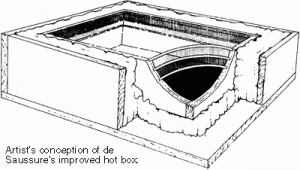 1767 : Swiss scientist Horace de Saussure first recorded a solar device which was a collector in 1767. He experimented with trapping solar heat using boxes made of glass, and later refined his design to include outer shells of black wood coated with insulation. Although it was an experiment the designs were also later used as the first solar ovens.
The 1800's


The 1900s
Mid-1950s


1970s
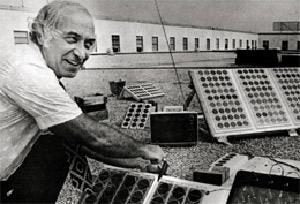
1970 : With the help from Exxon Corporation, Dr. Elliot Berman designed a cheaper solar cell which was available at $20 a watt. Solar cells begin to power navigation warning lights and horns on many offshore gas and oil rigs, lighthouses, railroad crossings and domestic solar applications began to be viewed as sensible applications in remote locations where grid-tied utilities could not exist affordably.
1972 : The French install a cadmium sulfide (CdS) photovoltaic system to operate an educational television at a village school in Niger. The Institute of Energy Conversion was established at the University of Delaware to perform research and development on thin-film photovoltaic (PV) and solar thermal systems, later on it became the world's first laboratory dedicated to PV research and development. 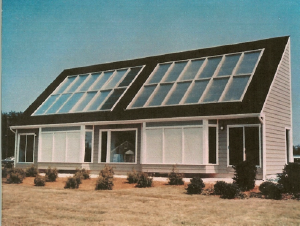
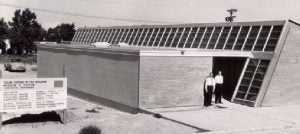
1973 : The University of Delaware builds 'Solar One,' one of the world's first photovoltaic (PV) powered residences. The system is a PV/thermal hybrid. In addition to electricity, the arrays acted as flat-plate thermal collectors, with fans blowing the warm air from over the array to phase-change heat-storage bins
. 
1977 : The Solar Energy Research Institute (National Renewable Energy Laboratory) was launched by U.S. Department of Energy, a federal facility dedicated to harnessing power from the sun.
1978 : NASA installs a solar power system on the Papago Indian Reservation located in southern Arizona-the world's first village PV system to provide for water pumping and residential electricity in 15 homes until 1983, when grid power reached the village.
1980 : ARCO Solar becomes the first company to produce more than 1 megawatt of photovoltaic modules in one year.
1980 : The first thin-film solar cell was produced at the University of Delaware, which exceeds 10% efficiency using copper sulfide/cadmium sulfide. 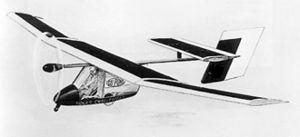
1981 : Paul MacCready builds the first solar-powered aircraft, which had over 16,000 solar cells mounted on its wings, producing 3,000 watts of power.
1982 :
- The first, photovoltaic megawatt-scale power station goes on-line in Hisperia, California consisting of 1-megawatt capacity system, developed by ARCO Solar.
- Australian Hans Tholstrup, the founder of the World Solar Challenge in Australia drives the first solar-powered car almost 2,800 miles between Sydney and Perth in 20 days.
- The U.S. Department of Energy, along with an industry consortium, began operating Solar One, a 10-megawatt central-receiver demonstration project.
- Volkswagen of Germany begins testing photovoltaic arrays mounted on the roofs of Dasher station wagons; generating 160 watts for the ignition system.
- The production of photovoltaic exceeds 9.3 megawatts Worldwide.
1983 : ARCO Solar completes a 6-megawatt photovoltaic substation in central California which supplies the Pacific Gas & Electric Company's utility grid with enough power for over 2,000 homes.
1983 : Solar Design Associates completes a stand-alone, 4-kilowatt powered home in the Hudson River Valley. Worldwide photovoltaic production exceeds 21.3 megawatts, with sales of more than $250 million.
1984 : The Sacramento Municipal Utility District commissions its first 1-megawatt photovoltaic electricity generating facility.
1985 : The University of South Wales breaks the 20% efficiency barrier for silicon solar cells under 1-sun conditions.
1986 : The world's largest solar thermal facility was commissioned in Kramer Junction, California. The solar field contained rows of mirrors that concentrated the sun's energy onto a system of pipes circulating a heat transfer fluid which was used to produce steam connected to a conventional turbine to generate electricity.
1992 :
- The University of South Florida develops a 15.9% efficient thin-film photovoltaic cell made of cadmium telluride, breaking the 15% barrier for the first time for this technology.
- A 7.5-kilowatt prototype dish system becomes operational using an advanced stretched-membrane concentrator.
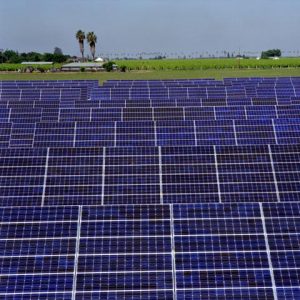

- The National Renewable Energy Laboratory (NERL) completes construction of its Solar Energy Research Facility. They develop a GaInP/GaAs two-terminal concentrator cell which becomes the first solar cell to exceed 30% conversion efficiency.
- First solar dish generator using a free-piston Stirling engine is tied to a utility grid.
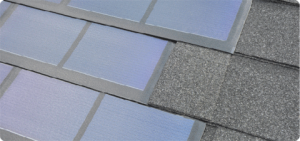 1998 : Subhendu Guha, a noted scientist led the invention of flexible solar shingles, a roofing material and state-of-the-art technology for converting sunlight to electricity. This is used in integrated solar technology which allows homeowners to install low-profile panels.
The 2000s

- Astronauts begin installing solar panels at the International Space Station, on what will be the largest solar power array deployed in space. Each wing of the array consists of 32,800 solar cells.
- Sandia National Laboratories develops a new inverter for solar electric systems that will increase the safety of the systems during a power outage. Inverters convert the direct current (DC) electrical output from solar systems into alternating current (AC), which is the standard current for household wiring and for the power lines that supply electricity to homes.
- Two new thin-film solar modules, developed by BP Solarex, break previous performance records. The company's 0.5-square-meter module achieves 10.8 % conversion efficiency-the highest in the world for thin-film modules of its kind. And its 0.9-square-meter module achieved 10.6% conversion efficiency and a power output of 91.5 watts - the highest power output for any thin-film module in the world.
- A family in Morrison, Colorado, installs a 12-kilowatt solar electric system on its home-the largest residential installation in the United States to be registered with the U.S. Department of Energy's Million Solar Roofs program.
- Home Depot begins selling residential solar power systems in three of its stores in San Diego, California. A year later it expands sales to include 61 stores nationwide.
- The world's largest hybrid system goes on-line in Hawaii. This system combines the power from both wind and solar energy.
- Powerlight Corporation installs the largest rooftop solar power system in the United States-a 1.18 megawatt system-at the Santa Rita Jail in Dublin, California.
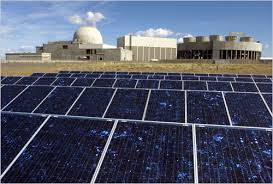
- A 38.7-kilowatt White Bluffs Solar Station (the largest solar power facility in the Northwest) goes on-line in Richland, Washington.
- ATS Automation Tooling Systems Inc. in Canada starts to commercialize a method of producing solar cells, called Spheral Solar technology. However this technology dropped production in the early 1990s, pioneered by Texas Instruments.
2004 : Some photo electro-chemical cells simply produce electrical energy, while others produce hydrogen in a process similar to the electrolysis of water. The latter form is currently being studied as a potential way to convert solar energy into a portable, transportable form (hydrogen).
2006 :
- Polysilicon use in photovoltaics exceeds all other polysilicon use for the first time.
- California Public Utilities Commission approved the California Solar Initiative (CSI), a comprehensive $2.8 billion program that provides incentives toward solar development over 11 years.
- New World Record Achieved in Solar Cell Technology – New Solar Cell Breaks the “40 Percent Efficient” Sunlight-to-Electricity Barrier
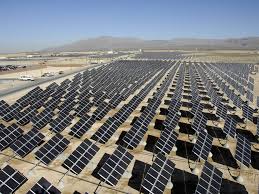
- Construction of Nellis Solar Power Plant, a 15 MW PPA installation.
- The Vatican started installing solar panels on some buildings, in “a comprehensive energy project that will pay for itself in a few years” in order to conserve earth’s resources.
- Google solar panel project begins its operation.
- University of Delaware claims to achieve new world record in Solar Cell Technology without independent confirmation – 42.8% efficiency.
- Nanosolar ships the first commercial printed CIGS, claiming that they will eventually ship for less than $1/Watt.
2008 : Scientists at the U.S. Department of Energy’s National Renewable Energy Laboratory (NREL) have set a world record with a photovoltaic device that converts 40.8 percent of the light that hits it into electricity. The inverted metamorphic triple-junction solar cell was designed, fabricated and independently measured at NREL.
2010 :
- BP announces the closing of their photovoltaic plant in Maryland, moving all of their manufacturing work to China.
- President Barack Obama orders installation of additional solar panels and a solar hot water heater at the White House.
- Fast-growing factories in China drive the manufacturing costs down to about $1.25 per watt for silicon photovoltaic modules.
Author : Arunima